DFIR First Image Analysis: Magnet AXIOM Walkthrough
Magnet AXIOM examination of the Dell Latitude CPi image, covering OS and install artifacts, user attribution, network configuration, installed hacking tools, webmail, and malware triage.

DFIR First Image Analysis — Magnet AXIOM
Tool: Magnet AXIOM Examine v10.2.0.49217
Evidence source:4Dell Latitude CPi.E01
Scope: Q2–Q15 only. Q1 is intentionally omitted.
This write-up documents the findings obtained from the supplied forensic image using Magnet AXIOM. Each answer is supported by the AXIOM artifacts or file-system evidence shown in the accompanying screenshots.
Quick Answer Summary
| Question | Answer |
|---|---|
| Q2 | Microsoft Windows XP, Version 5.1 |
| Q3 | 19 August 2004, 10:48:27 PM |
| Q4 | Greg Schardt |
| Q5 | N-1A9ODN6ZXK4LQ |
| Q6 | 27 August 2004, 3:46:33 PM |
| Q7 | 5 accounts |
| Q8 | Mr. Evil |
| Q9 | Xircom CardBus Ethernet 100 + Modem 56; Compaq WL110 Wireless LAN PC Card |
| Q10 | IP 192.168.1.111; MAC 00:10:A4:93:3E:09 |
| Q11 | Multiple network, password-recovery, packet-capture and wireless-discovery tools were installed |
| Q12 | Forte Agent |
| Q13 | whoknowsme@sbcglobal.net |
| Q14 | 4 executable files |
| Q15 | Yes — unix_hack.tgz was identified as malicious/suspicious by multiple security engines |
Q2. What operating system was used on the computer?
Answer
Microsoft Windows XP, Version 5.1
Investigation
In AXIOM Examine, I navigated to:
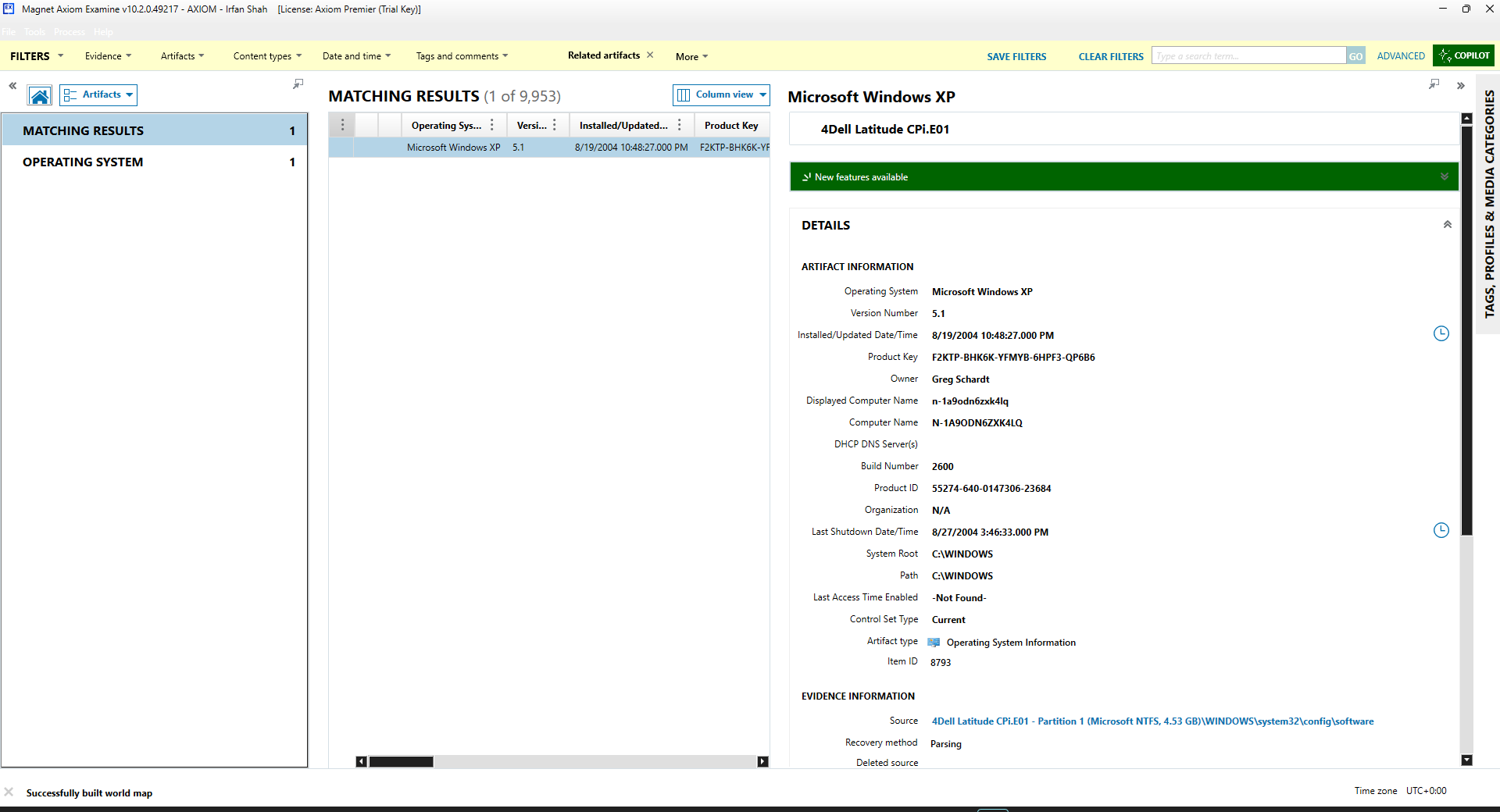
Artifacts → Operating System → Operating System Information
AXIOM parsed the Windows registry and displayed the operating-system information for the evidence source. The artifact identified the operating system as Microsoft Windows XP with version number 5.1.
Evidence
Finding
The forensic image contains an installation of Microsoft Windows XP.
Q3. When was the install date?
Answer
19 August 2004 at 10:48:27 PM
Investigation
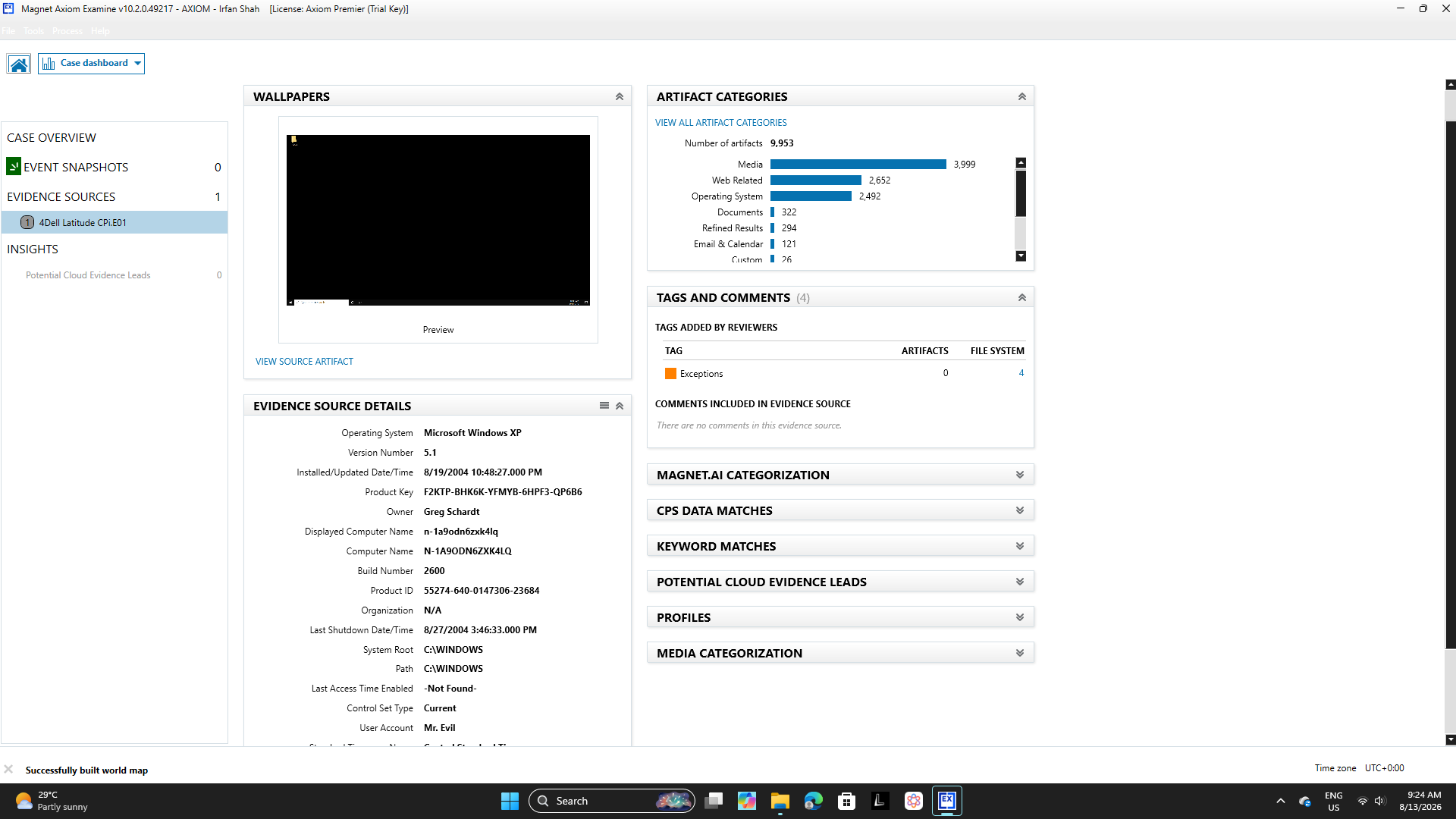
The installation timestamp was available in the same Operating System Information artifact. AXIOM displayed:
Installed/Updated Date/Time: 8/19/2004 10:48:27.000 PM
The AXIOM interface in the supplied screenshot is configured to display timestamps in UTC+00:00.
Evidence
Finding
Windows was installed or updated on 19 August 2004 at 10:48:27 PM.
Q4. Who is the registered owner?
Answer
Greg Schardt
Investigation
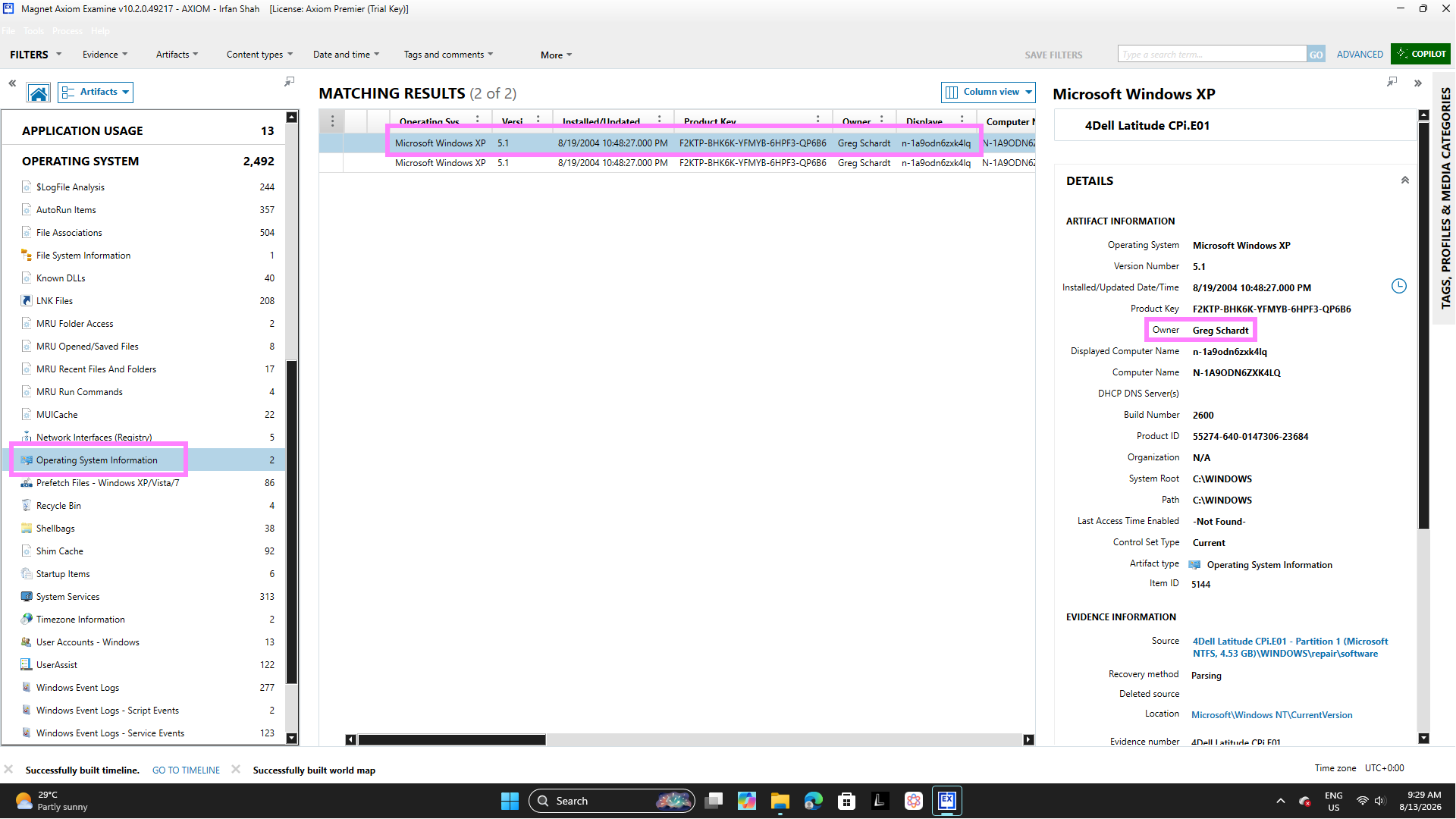
Under Operating System Information, AXIOM recovered the registered owner from the Windows registry. The Owner field contains:
Greg Schardt
Evidence
Finding
The Windows installation is registered to Greg Schardt.
Q5. What is the computer account name?
Answer
N-1A9ODN6ZXK4LQ
Investigation
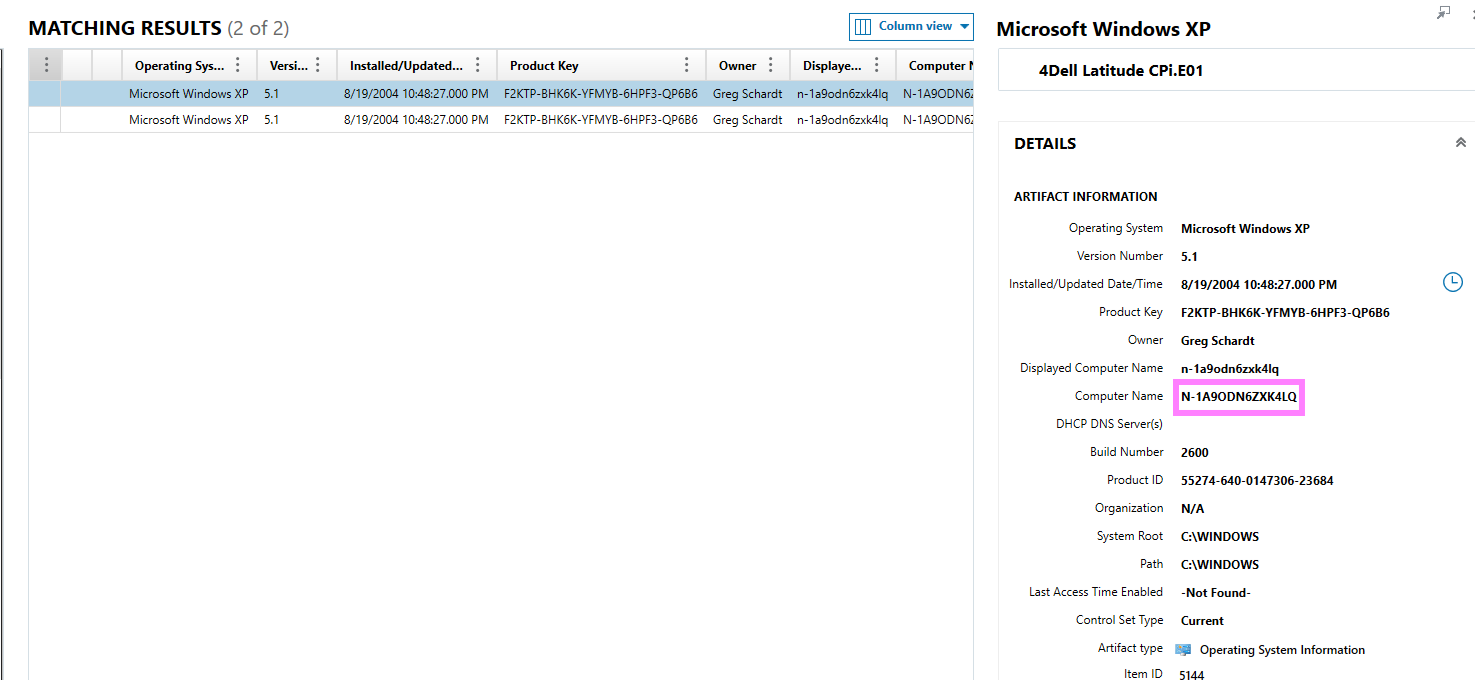
The computer name was recovered from AXIOM’s Operating System Information artifact.
The relevant field shows:
Computer Name: N-1A9ODN6ZXK4LQ
Evidence
Finding
The computer account/name is N-1A9ODN6ZXK4LQ.
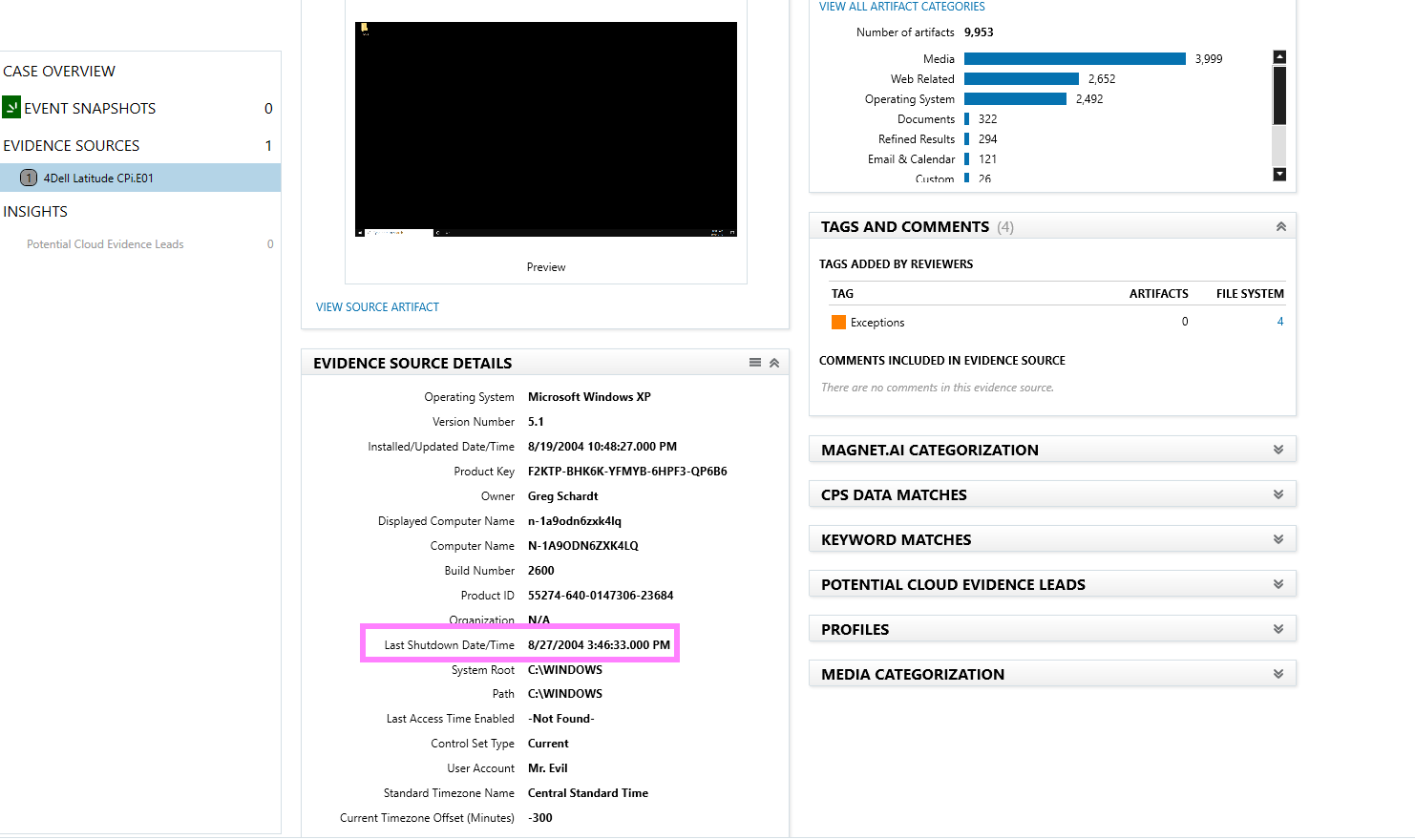
Q6. When was the last recorded computer shutdown date/time?
Answer
27 August 2004 at 3:46:33 PM
Investigation
The Evidence Source Details section contained the parsed shutdown timestamp:
Last Shutdown Date/Time: 8/27/2004 3:46:33.000 PM
Evidence
Finding
The last shutdown recorded by AXIOM occurred on 27 August 2004 at 3:46:33 PM.
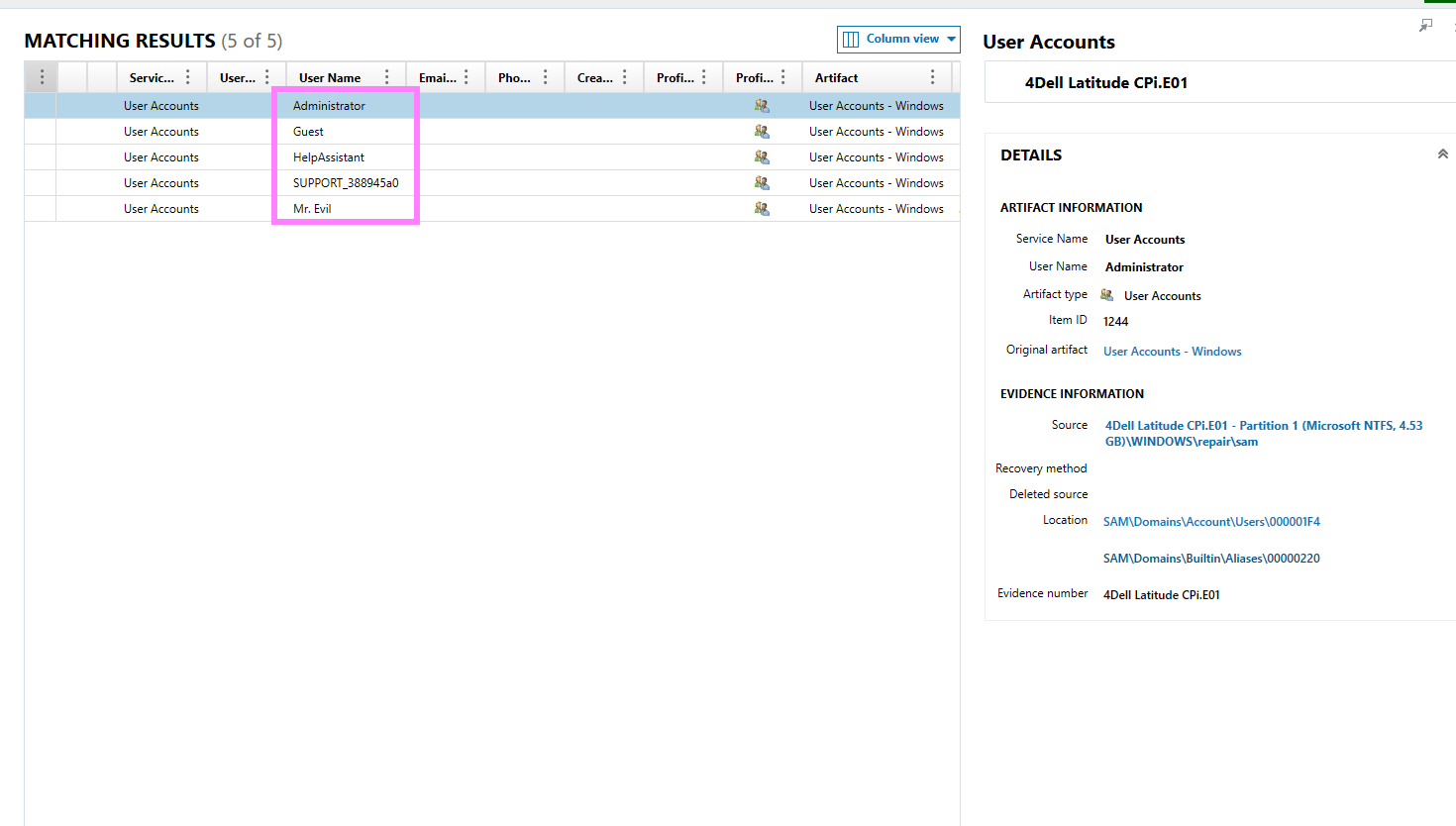
Q7. How many accounts are recorded?
Answer
5 user accounts
Investigation
I navigated to the Windows user-account artifacts in AXIOM. Five accounts were recovered:
AdministratorGuestHelpAssistantSUPPORT_388945a0Mr. Evil
Evidence
Finding
A total of 5 Windows user accounts are recorded in the forensic image.
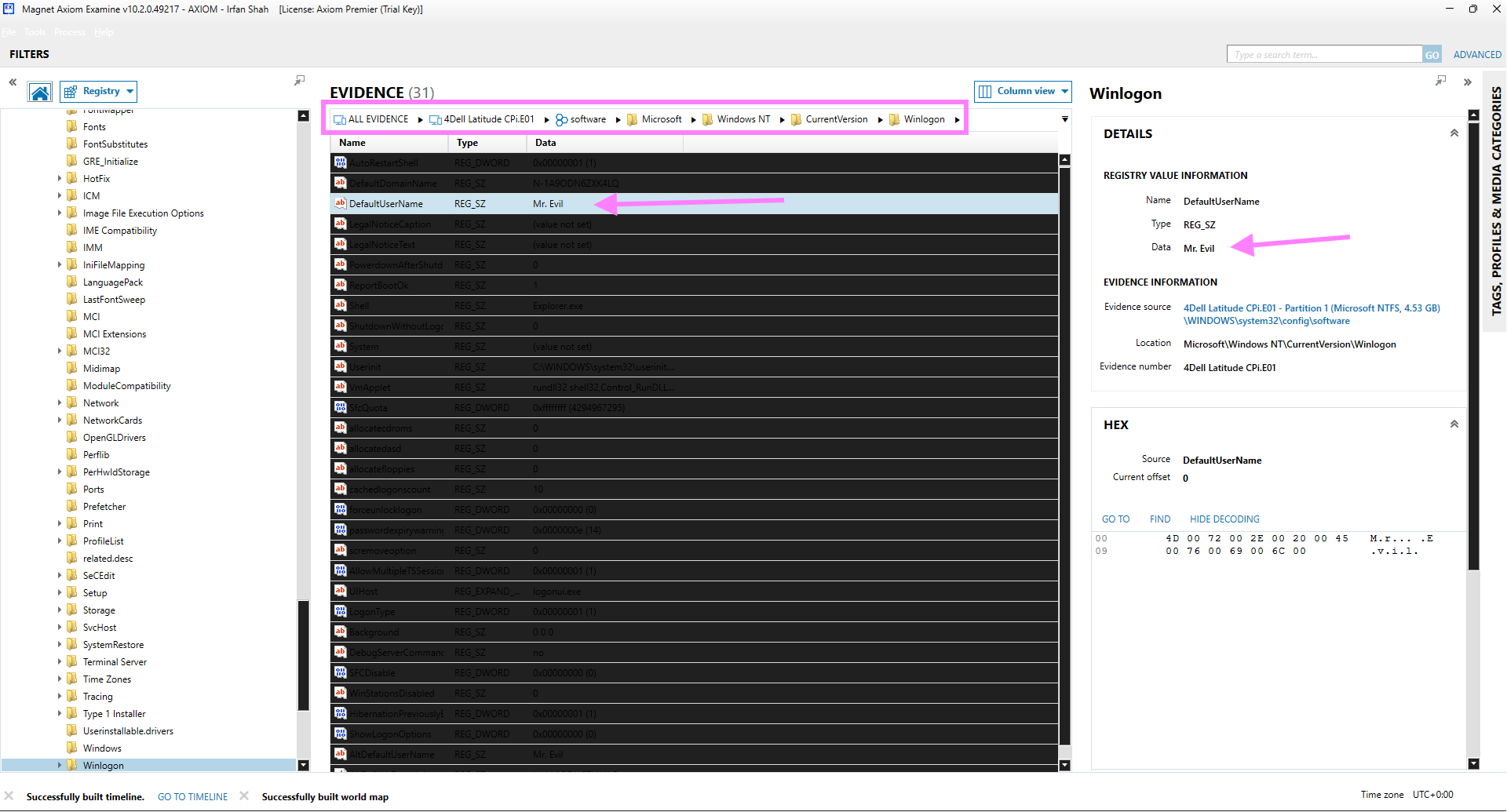
Q8. Who was the last user to log on to the computer?
Answer
Mr. Evil
Investigation
I examined the Windows registry in AXIOM at:
Microsoft\Windows NT\CurrentVersion\Winlogon
The registry value:
DefaultUserName
contained:
Mr. Evil
Evidence
Finding
The registry evidence identifies Mr. Evil as the last/default interactive user associated with the Winlogon configuration.
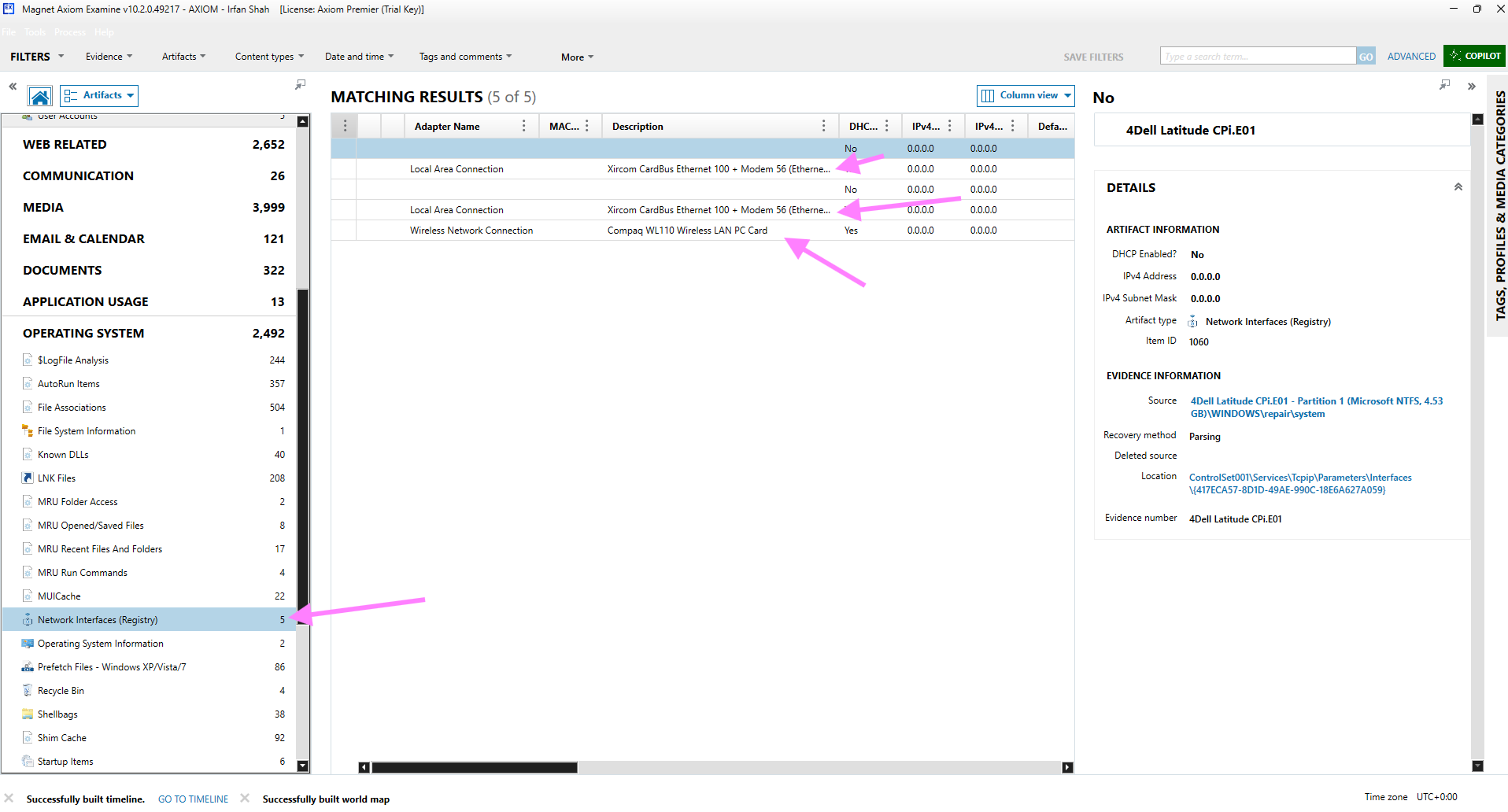
Q9. List the network cards used by this computer.
Answer
Two network adapters were identified:
- Xircom CardBus Ethernet 100 + Modem 56 (Ethernet Interface)
- Compaq WL110 Wireless LAN PC Card
Investigation
I navigated to:
Artifacts → Operating System → Network Interfaces (Registry)
AXIOM displayed both wired and wireless network-interface descriptions.
Evidence
Finding
The system had both a Xircom wired Ethernet adapter and a Compaq WL110 wireless LAN adapter configured.
Q10. What is the IP address and MAC address of the computer?
Answer
- IP address:
192.168.1.111 - MAC address:
00:10:A4:93:3E:09
Investigation
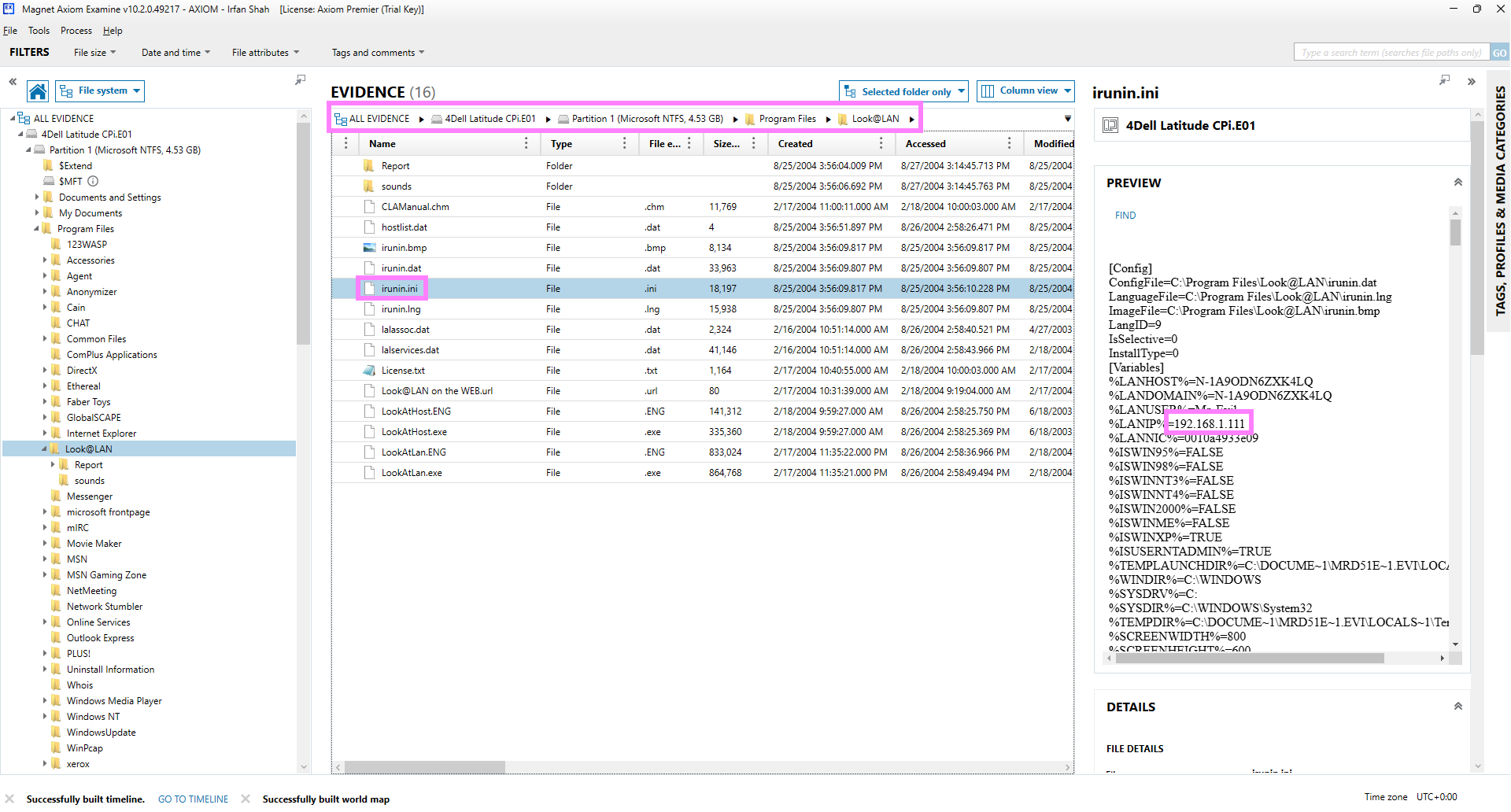
The strongest evidence for the address used by the computer during the Look@LAN configuration was found in:
C:\Program Files\Look@LAN\irunin.ini
The file contained the following variables:
%LANIP%=192.168.1.111
%LANNIC%=0010a4933e09
The NIC value can be formatted as a standard MAC address:
00:10:A4:93:3E:09
Evidence
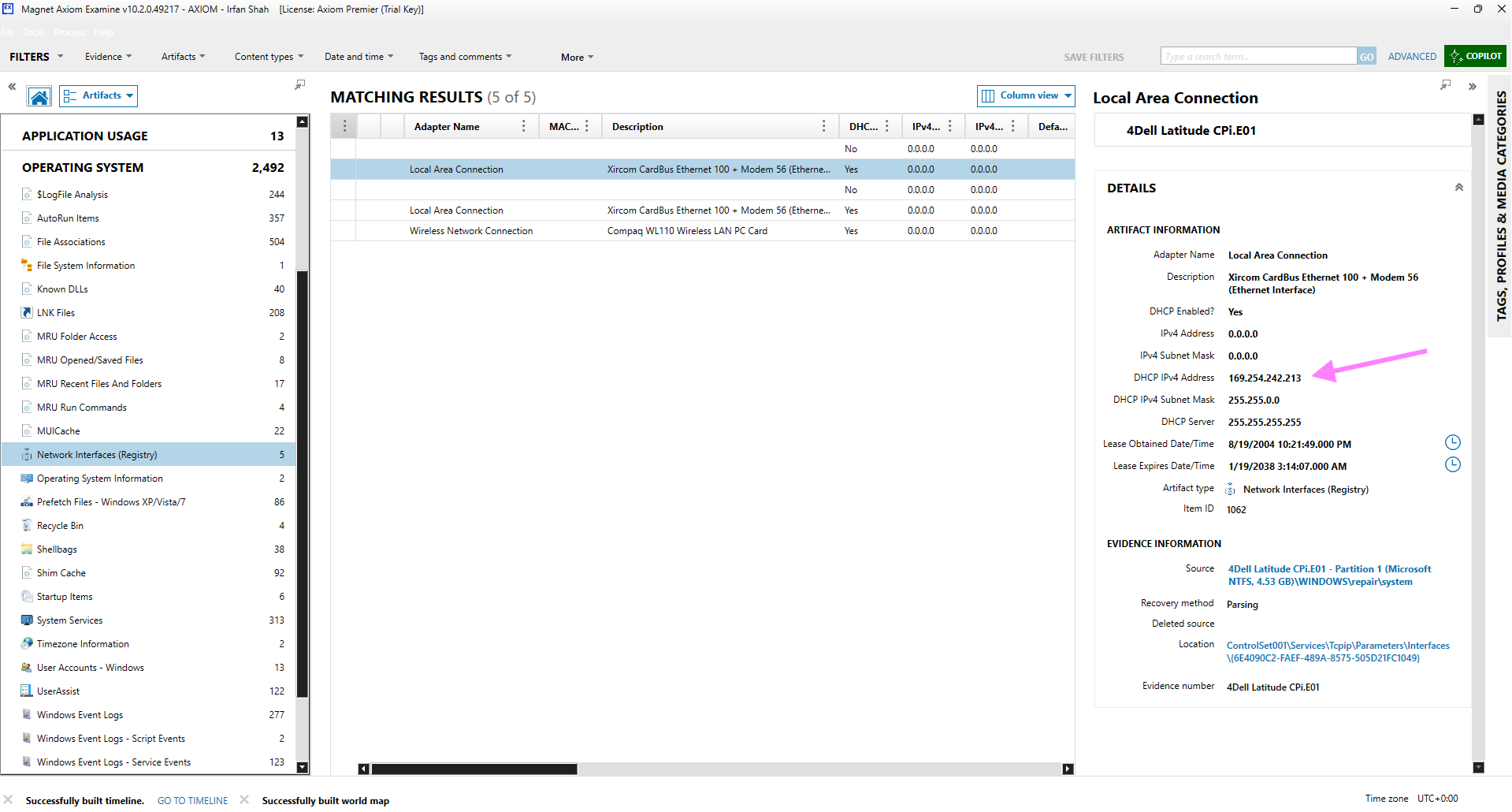
AXIOM also recovered a registry network-interface entry containing the APIPA address 169.254.242.213. This represents another DHCP/interface state. For this question, the Look@LAN configuration provides the IP/MAC pair associated with the program setup.
Finding
The Look@LAN configuration associates the machine with 192.168.1.111 and MAC address 00:10:A4:93:3E:09.
Q11. Search for programs/tools that aided in the crime (Wireless Hacking).
Answer
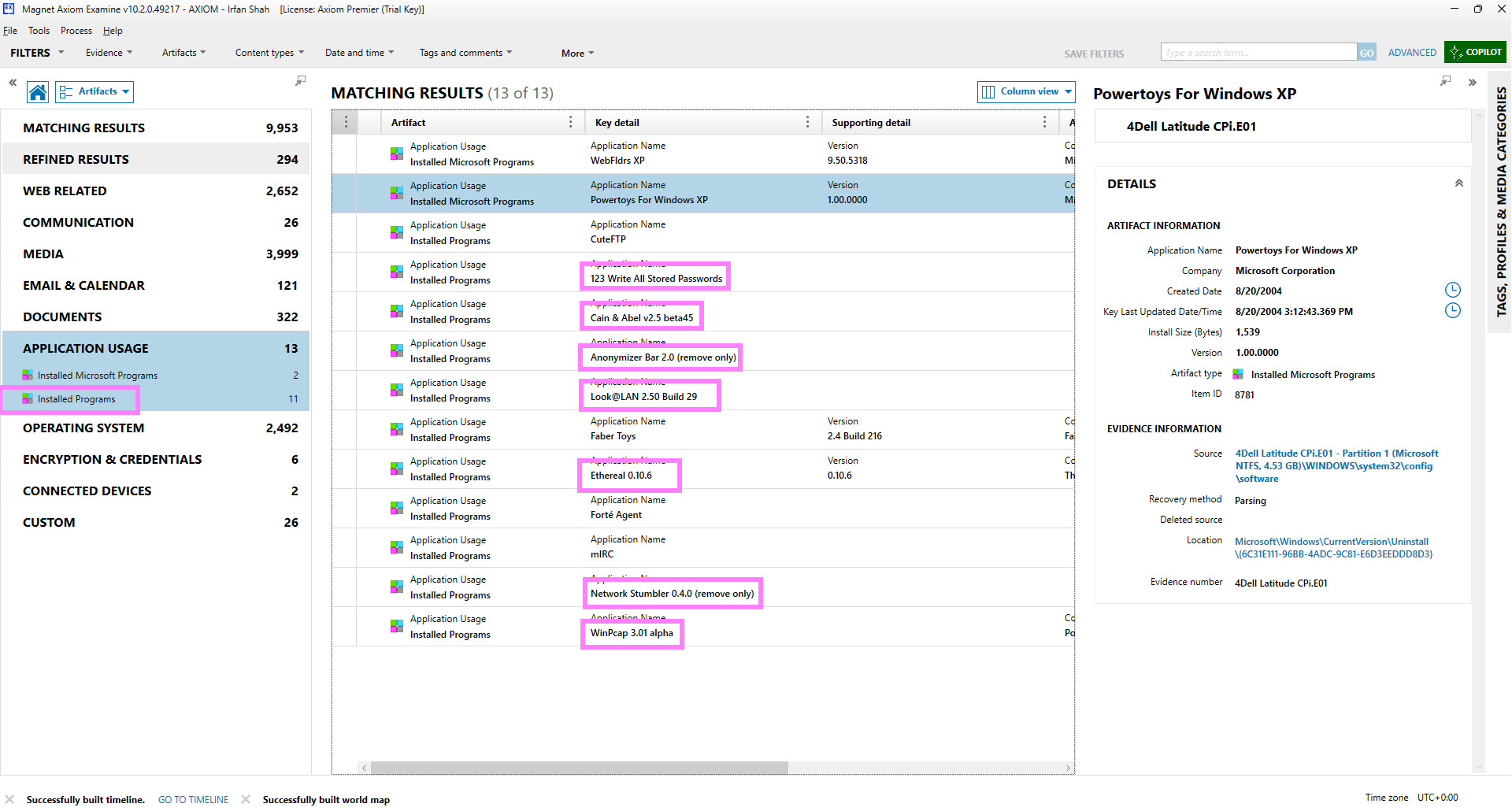
AXIOM recovered several installed programs that could support network reconnaissance, wireless discovery, packet capture, credential recovery, or anonymity:
- 123 Write All Stored Passwords
- Cain & Abel v2.5 beta45
- Anonymizer Bar 2.0
- Look@LAN 2.50 Build 29
- Ethereal 0.10.6
- Network Stumbler 0.4.0
- WinPcap 3.01 alpha
Investigation
I navigated to:
Artifacts → Application Usage → Installed Programs
AXIOM displayed the installed-program entries recovered from the Windows system.
Evidence
Forensic Significance
The combination of these programs is significant because the machine contains tools capable of:
- wireless network discovery,
- LAN reconnaissance,
- packet capture,
- credential/password recovery, and
- anonymized browsing.
The presence of a tool alone does not prove malicious use, but the collection is relevant to an investigation involving wireless hacking.
Q12. Which email client is used by Mr. Evil?
Answer
Forte Agent
Investigation
The following file was examined:
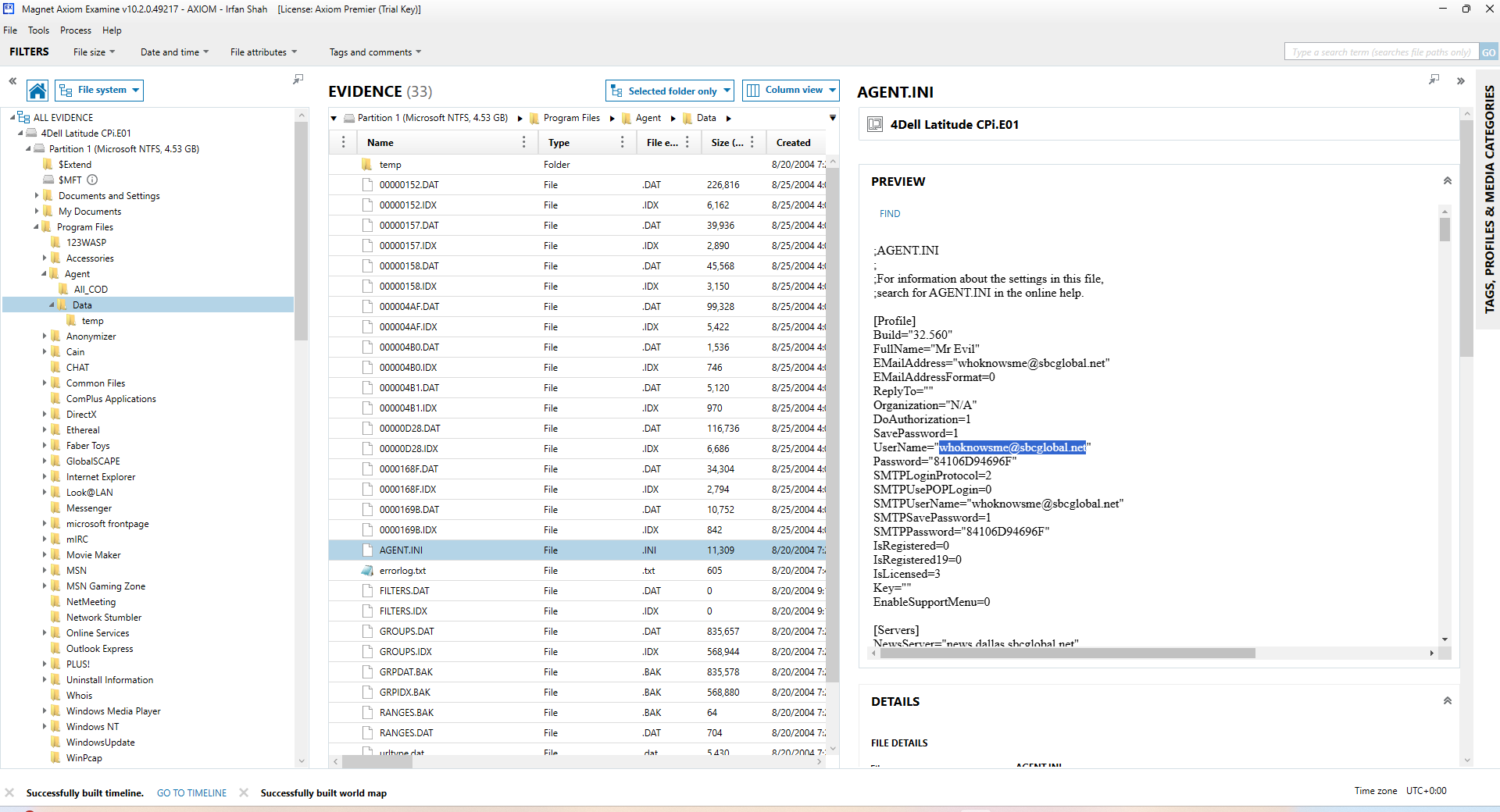
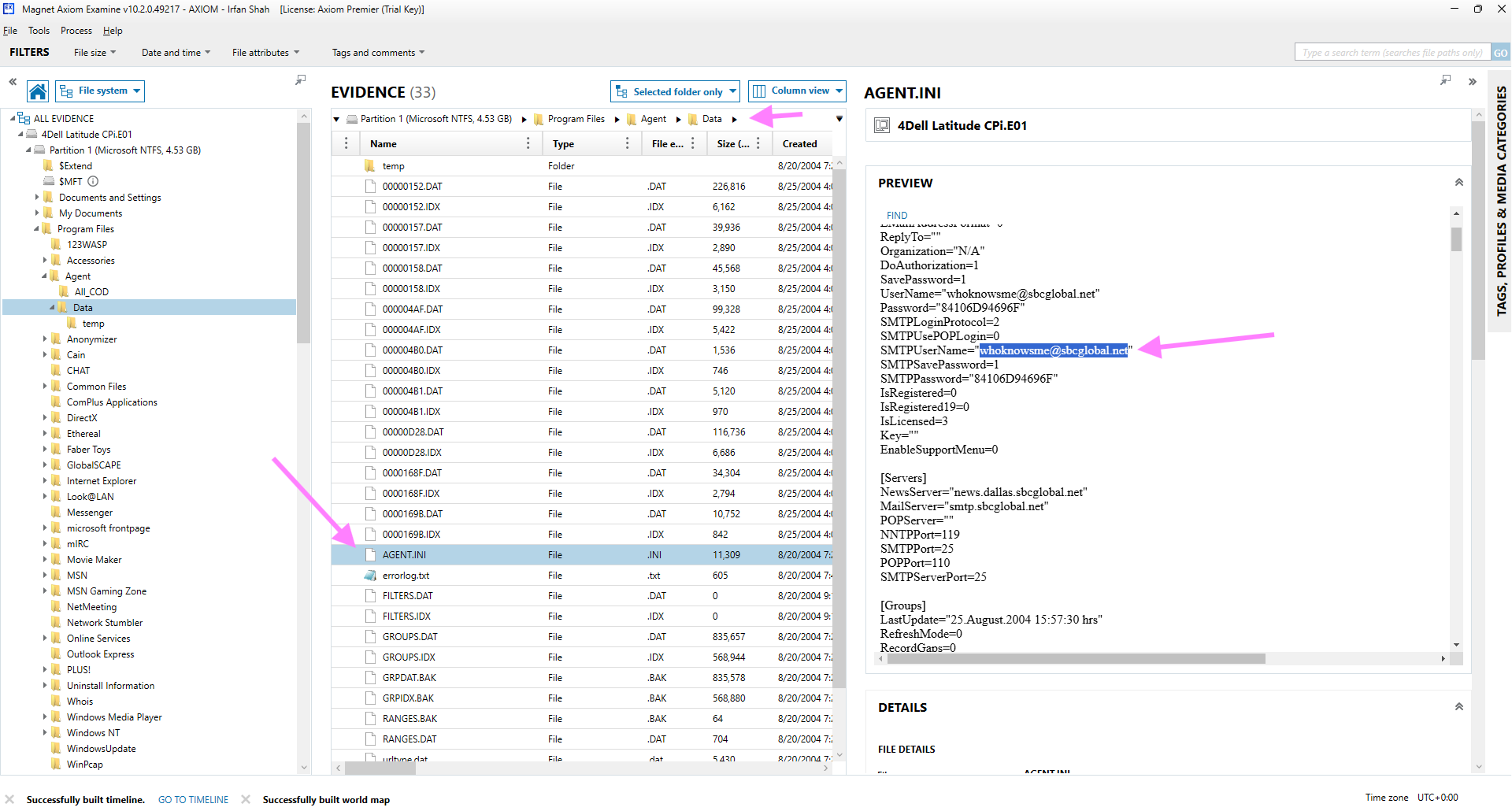
C:\Program Files\Agent\Data\AGENT.INI
The configuration contains a profile with:
FullName="Mr Evil"
EmailAddress="whoknowsme@sbcglobal.net"
Because the profile is stored under the Agent application directory and directly identifies Mr. Evil, it provides evidence that Forte Agent was being used.
Evidence
Finding
The email/news client associated directly with the Mr. Evil profile is Forte Agent.
Q13. What is the SMTP email address for Mr. Evil?
Answer
whoknowsme@sbcglobal.net
Investigation
The AGENT.INI file contains:
UserName="whoknowsme@sbcglobal.net"
SMTPUserName="whoknowsme@sbcglobal.net"
MailServer="smtp.sbcglobal.net"
SMTPPort=25
Evidence
Finding
The SMTP account associated with Mr. Evil is whoknowsme@sbcglobal.net.
Q14. How many executable files are in the Recycle Bin?
Answer
4 executable files
Investigation
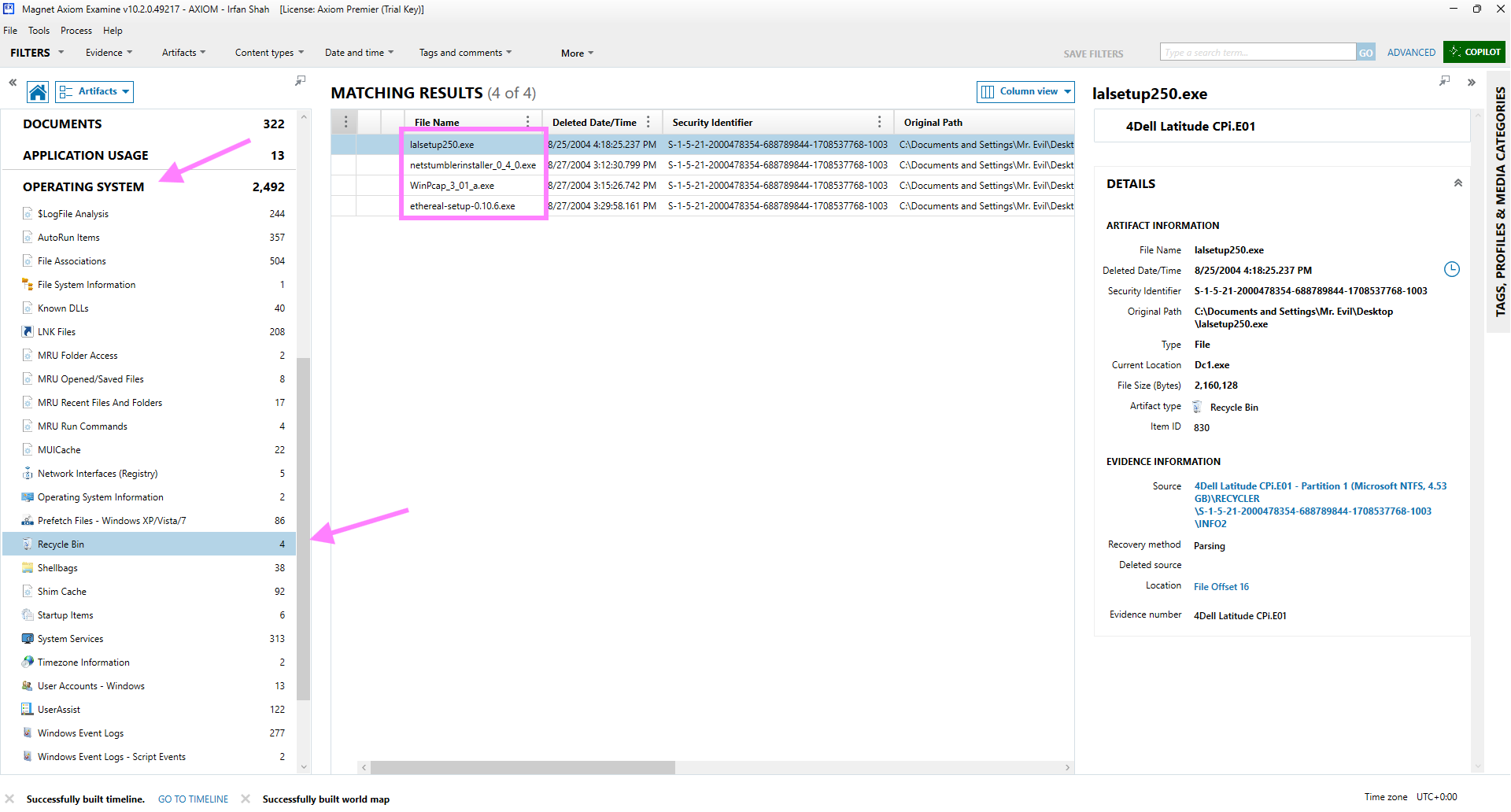
I navigated to:
Artifacts → Operating System → Recycle Bin
AXIOM recovered four deleted executable files:
lalsetup250.exenetstumblerinstaller_0_4_0.exeWinPcap_3_01_a.exeethereal-setup-0.10.6.exe
The original paths indicate that the files were deleted from the Mr. Evil user’s Desktop.
Evidence
Finding
There are 4 executable files recorded in the Recycle Bin artifacts.
Q15. Is there any malware on the computer?
Answer
Yes. A suspicious/malicious archive named unix_hack.tgz was identified.
Investigation
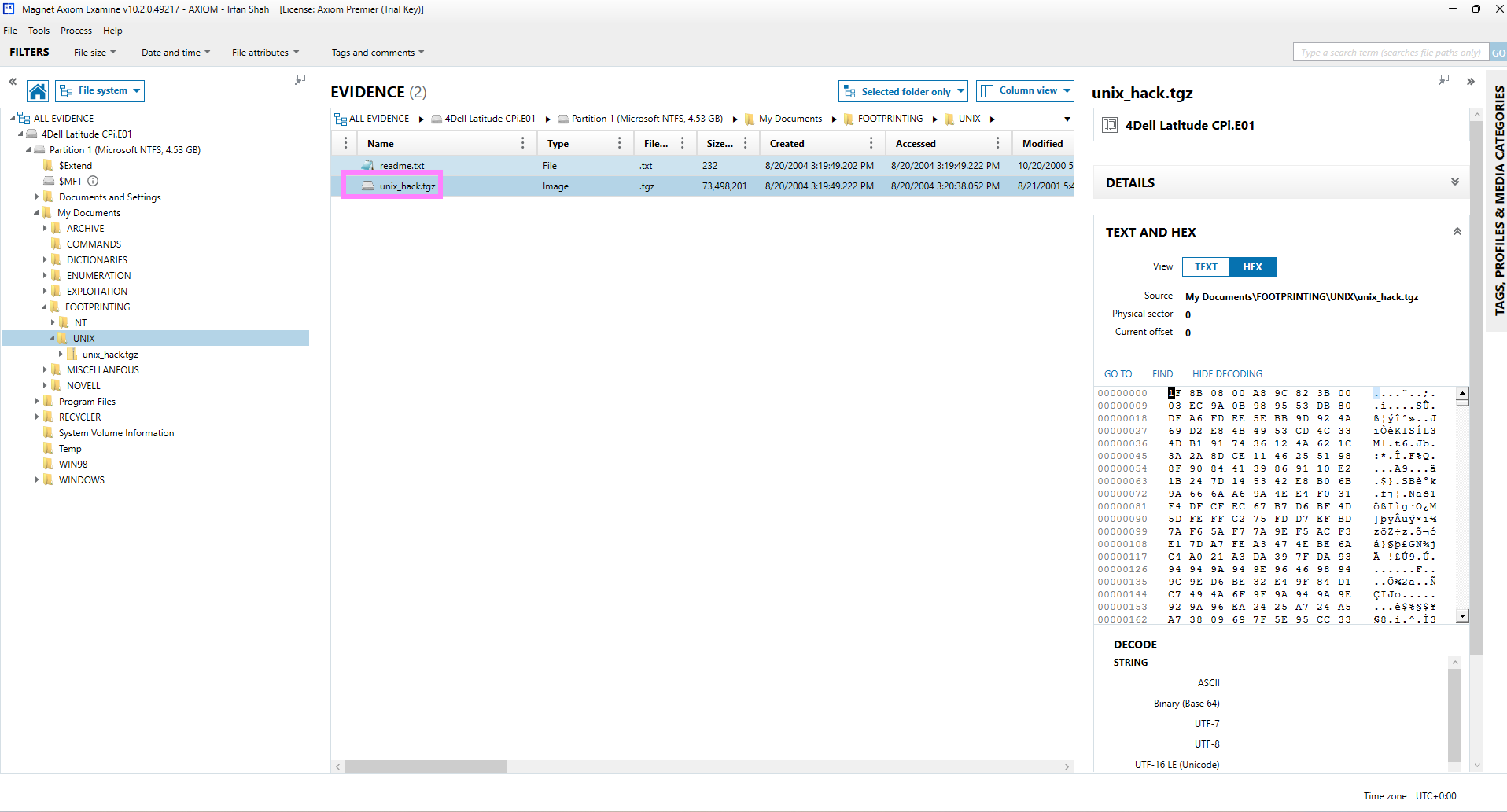
The file was located at:
C:\My Documents\FOOTPRINTING\UNIX\unix_hack.tgz
AXIOM displayed the file as approximately 73,498,201 bytes.
Evidence — File Location
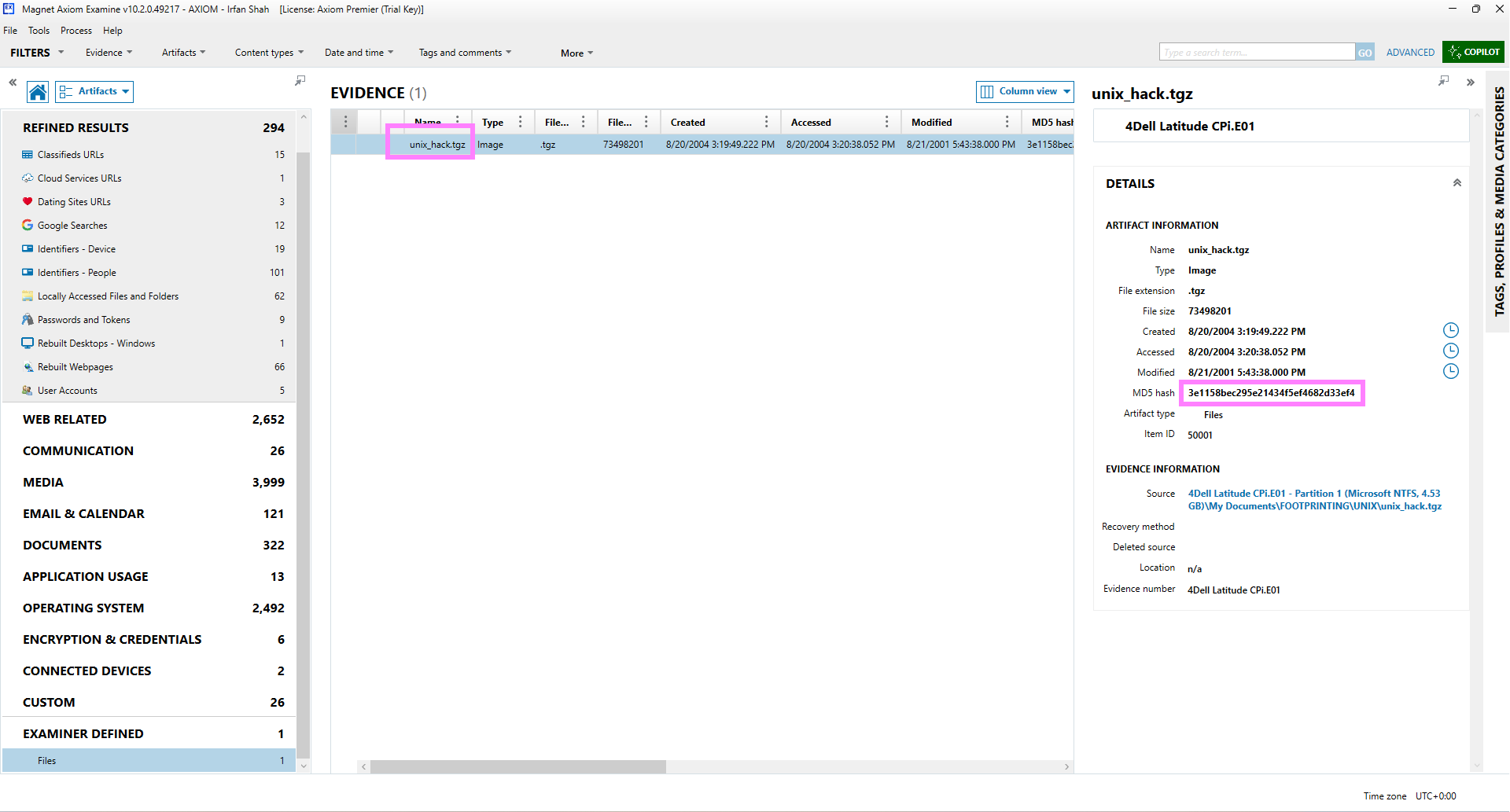
The AXIOM file artifact also displayed the following MD5 hash:
3e1158bec295e21434f5ef4682d33ef4
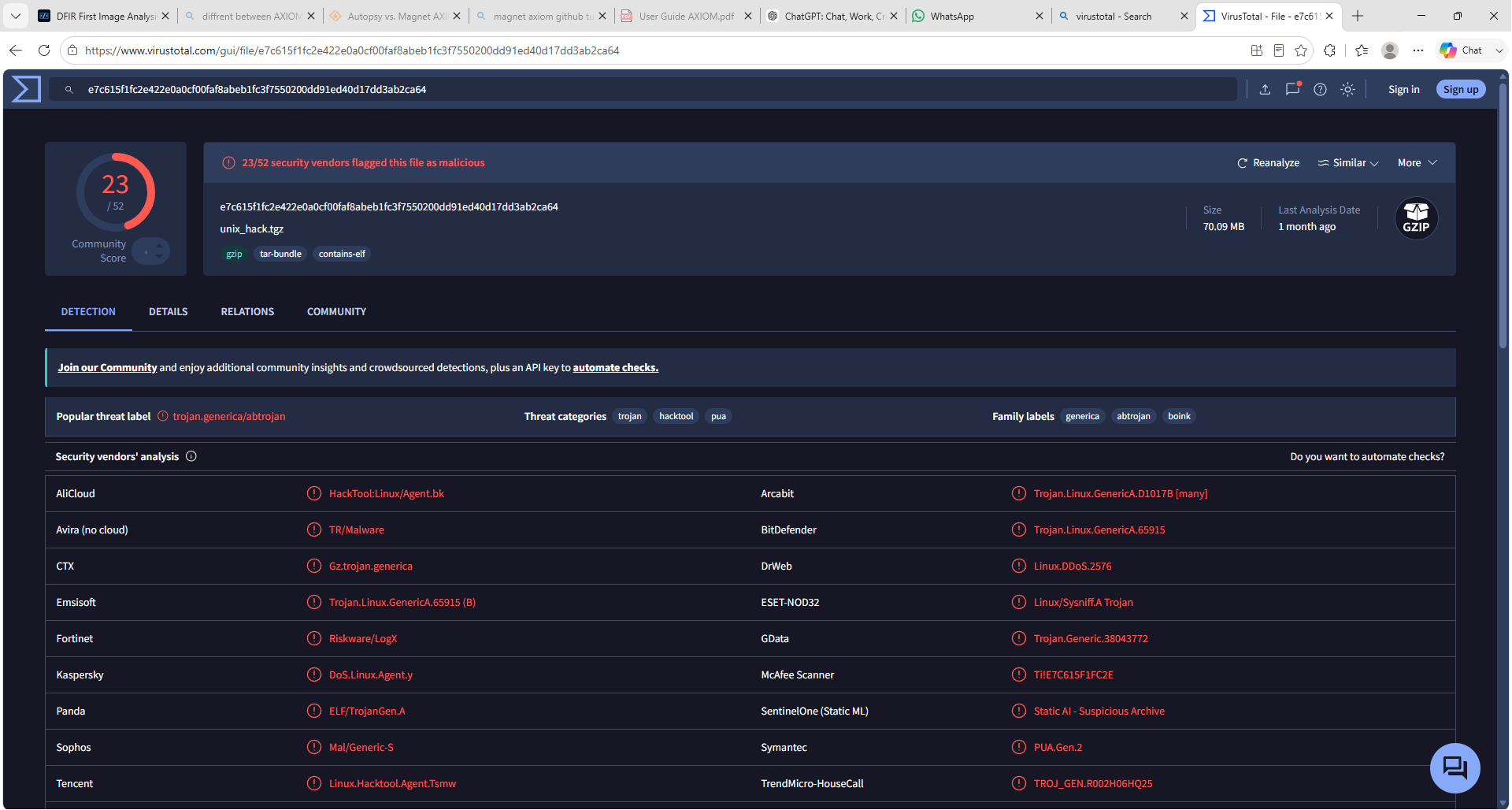
The supplied VirusTotal screenshot shows the archive being detected by 23 of 52 security vendors. Detection labels shown include Trojan, Linux hacktool, suspicious archive, and related classifications.
The VirusTotal SHA-256 shown in the supplied evidence is:
e7c615f1fc2e422e0a0cf00faf8abeb1fc3f7550200dd91ed40d17dd3ab2ca64
Evidence — VirusTotal
Finding
Based on the file location, hash analysis, and the multi-engine detections shown in the supplied VirusTotal evidence, unix_hack.tgz should be treated as malicious or potentially malicious evidence within this forensic image.
Related Writeups



Authorized security practice only. These notes are for lab, CTF, and explicitly permitted environments.