The Pocket Rocketman
Bahtera 3108 2025 cryptography writeup covering RSA with consecutive close primes, Fermat factorization, and plaintext recovery.

Challenge Overview
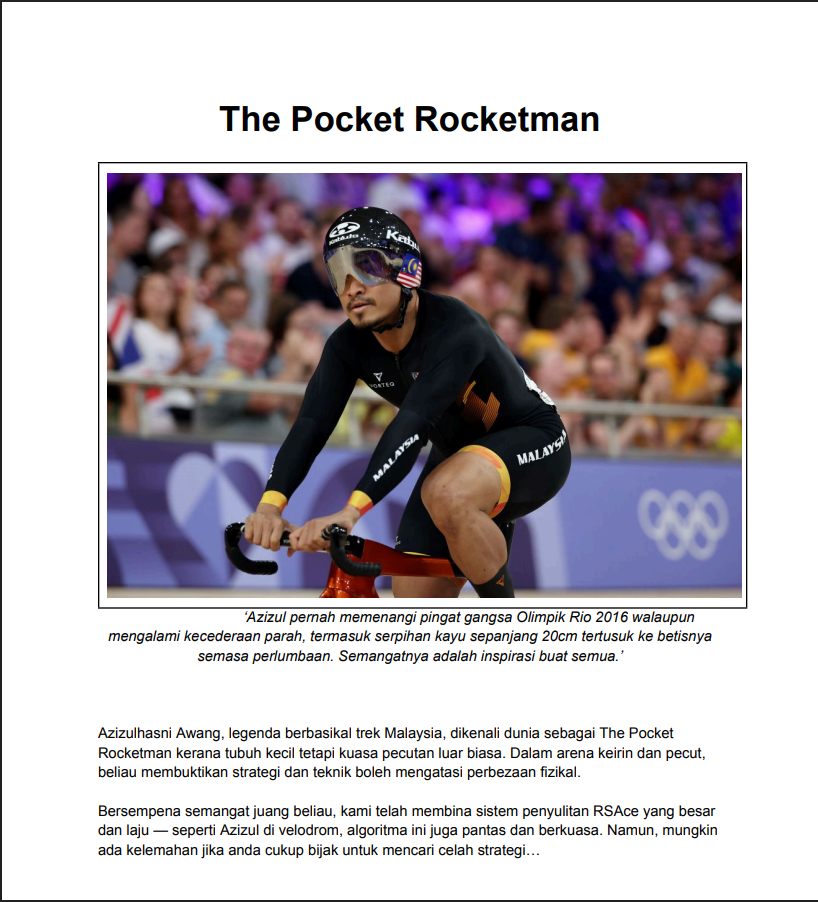
Azizulhasni Awang, legenda lumba basikal trek Malaysia, digelar The Pocket Rocketman kerana tubuhnya kecil tetapi kuasanya luar biasa. Dalam perlumbaan keirin, strategi, ketepatan, dan fokus menjadi senjata utama beliau.
The supplied challenge document is available here: The Pocket Rocketman challenge PDF.
The challenge uses RSA, but generates q as the next prime after p.
Challenge Source
from sympy import nextprime
from random import randint


def readFlag():
    with open("flag.txt", "r") as f:
        return f.readline().strip()


def main():
    size = 4096

    # Generate p near 2^size, then q as the next prime after p
    p = nextprime(randint(2**size, 2**(size + 1)))
    q = nextprime(p)

    n = p * q
    e = 65537

    print("n:", n)
    print("e:", e)

    flag = readFlag()
    message = int.from_bytes(flag.encode(), "big")

    ciphertext = pow(message, e, n)

    with open("output.txt", "w") as f:
        f.write(f"n: {n}\n")
        f.write(f"e: {e}\n")
        f.write(f"ciphertext: {ciphertext}\n")

    print("done output.txt")


if __name__ == "__main__":
    main()
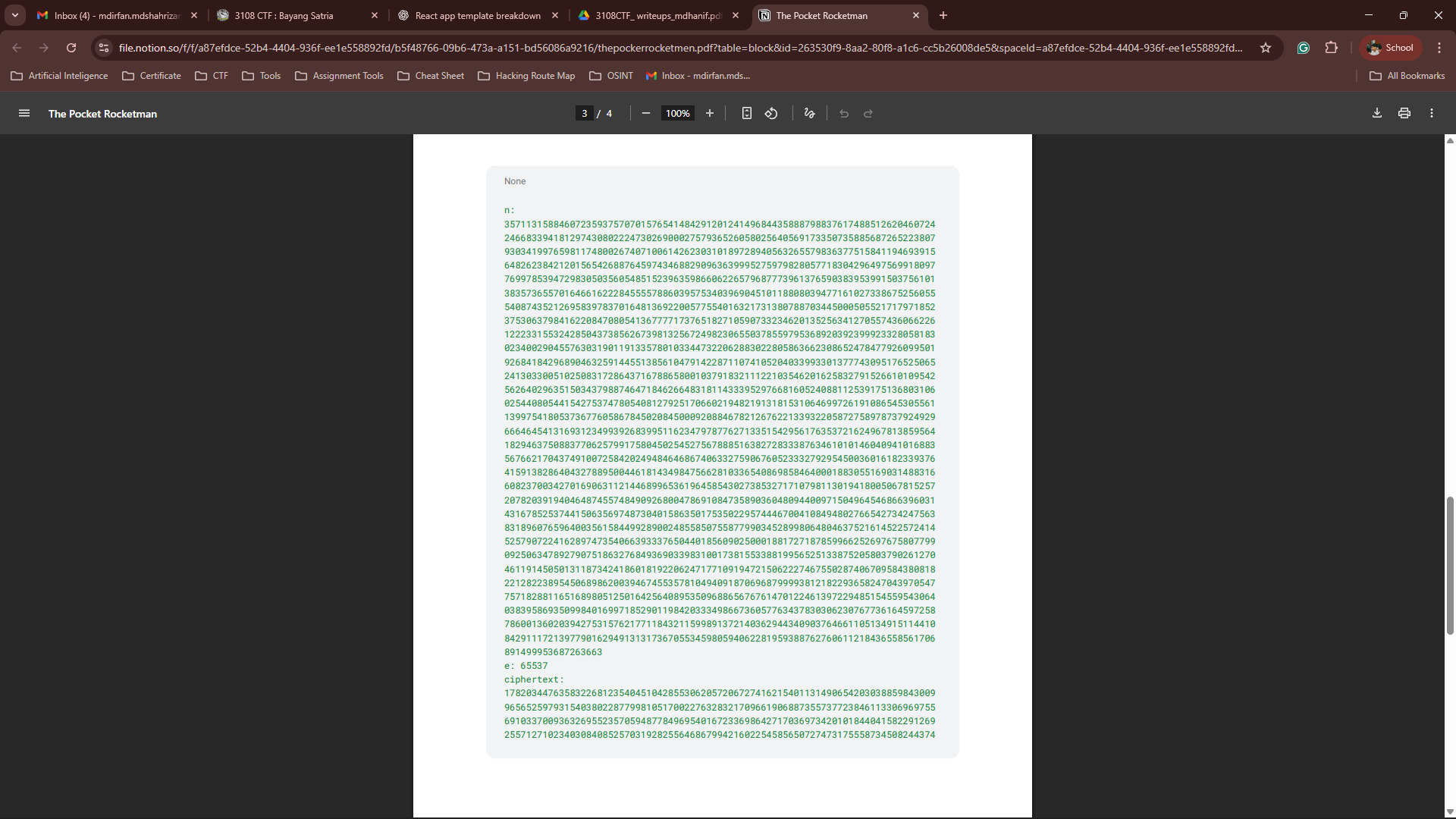
The challenge output contained the large modulus n, the public exponent e = 65537, and the ciphertext:
Weakness and Solution
The key-generation line is the weakness:
q = nextprime(p)This guarantees that p and q are extremely close. Fermat factorization searches for two squares where:
n = a^2 - b^2 = (a - b)(a + b)Because the factors are close, the search begins near sqrt(n) and reaches the correct pair quickly. After recovering p and q, the usual RSA calculations recover d and decrypt the ciphertext.
The recorded solver run confirms that the 8194-bit modulus was factored using this method:
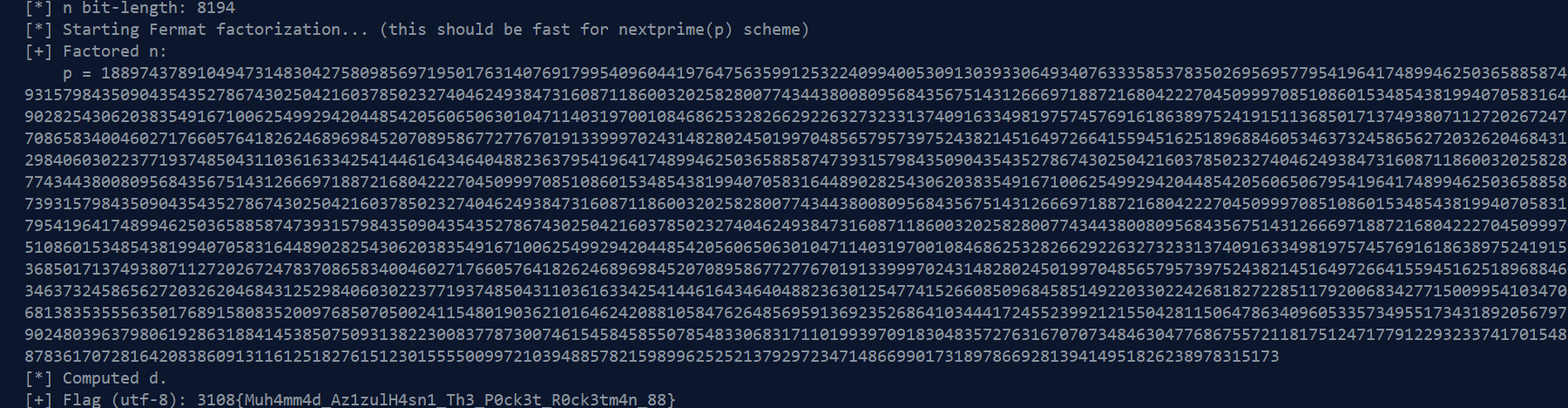
[*] n bit-length: 8194
[*] Starting Fermat factorization... (this should be fast for nextprime(p) scheme)
[+] Factored n
[*] Computed d.
[+] Flag (utf-8): 3108{Muh4mm4d_Az1zulH4sn1_Th3_P0ck3t_R0ck3tm4n_88}
Flag
3108{Muh4mm4d_Az1zulH4sn1_Th3_P0ck3t_R0ck3tm4n_88}Key Takeaway
Large RSA keys are not automatically secure. If the two primes are generated too close together, Fermat factorization can recover them efficiently even when the modulus is thousands of bits long.
Related Writeups

Authorized security practice only. These notes are for lab, CTF, and explicitly permitted environments.